Sabtu, 07 Juli 2012

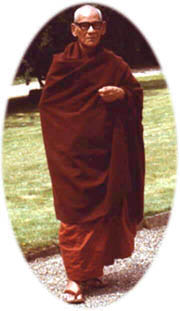
A Biography of Ajahn Maha Boowa

Maha Boowa Ñanasampanno, Phra Ajaan (1913-2011)
Venerable Ajaan Maha Boowa was born in Udorn-thani, North-east Thailand in 1913. He became a monk in the customary way at a local monastery and went on to study the Pali language and texts. At this time he also started to meditate but had not yet found a suitable Teacher. Then he caught sight of the Ven. Ajaan Mun and immediately felt that this was someone really special, someone who obviously had achieved something from his Dhamma practice.
After finishing his Grade Three Pali studies he therefore left the study monastery and followed Ven. Ajaan Mun into the forests of N.E. Thailand. When he caught up with Ven. Ajaan Mun, he was told to put his academic knowledge to one side and concentrate on meditation. And that was what he did. He often went into solitary retreat in the mountains and jungle but always returned for help and advice from Ven. Ajaan Mun. He stayed with Ven. Ajaan Mun for seven years, right until the Ven. Ajaan's passing away.
The vigor and uncompromising determination of his Dhamma practice attracted other monks dedicated to meditation and this eventually resulted in the founding of Wat Pa Bahn Tahd, in some forest near the village where he was born. This enabled his mother to come and live as a nun at the monastery.
Ven. Ajaan Maha Boowa is well known for the fluency and skill of his Dhamma talks, and their direct and dynamic approach. They obviously reflect his own attitude and the way he personally practiced Dhamma. This is best exemplified in the Dhamma talks he gives to those who go to meditate at Wat Pa Bahn Tahd. Such talks usually take place in the cool of the evening, with lamps lit and the only sound being the insects and cicadas in the surrounding jungle. He often begins the Dhamma talk with a few moments of stillness — this is the most preparation he needs — and then quietly begins the Dhamma exposition. As the theme naturally develops, the pace quickens and those listening increasingly feel its strength and depth.
The formal Dhamma talk might last from thirty-five to sixty minutes. Then, after a more general talk, the listeners would all go back to their solitary huts in the jungle to continue the practice, to try to find the Dhamma they had been listening about — inside themselves.

A Biography of Ajahn Sim


Sim Buddhacaro, Phra Ajaan (1909-1992)
Looang Boo Sim Buddhacaro was born on the 26th November 1909 in Sakhon Nakhon Province, North-East Thailand. His parents were farmers and dedicated supporters of the local monastery. At the age of 17 Looang Boo Sim took novice ordination and shortly afterwards became a disciple of the Ajaan Mun. Looang Boo Sim stayed with Ajaan Mun and various of his senior disciples for many years, taking full ordination at the age of 20 at Wat Sri Candaravasa, Khon Kaen.
In later years he was the Abbot of a number of monasteries in various parts of Thailand and was given the ecclesiastical title of Phra Khroo Santivaranana in 1959. In 1967 he established a monastery in the remote mountains of Chiang Dao in Chiang Mai province that remained his residence until his death in 1992.


Reference:http://www.accesstoinsight.org/lib/thai/index.html

A Biography of Ajahn Khamdee


Khamdee Pabhaso, Phra Ajaan (1902-1984)
Ajaan Khamdee was born into a farming family in Khon Kaen province in northeastern Thailand. At the age of 22 he ordained at the local temple in line with Thai custom, but was dissatisfied with the type of practice customary at village temples. As a result, in 1928 he reordained in the Dhammayut sect, and in the following year became a student of Ajaan Singh Khantiyagamo, a senior disciple of Ajaan Mun. Taking up the life of a wandering monk, he sought out quiet places in various parts of northeastern Thailand until coming to Tham Phaa Puu (Grandfather Cliff Cave) in Loei province, near the Laotian border, in 1955. Finding it an ideal place to practice, he stayed there for most of the remainder of his life, moving down to the foot of the hill below the cave when he became too old to negotiate the climb.
Well-known as a teacher of strong character and gentle temperament, he attracted a large following of students, both lay and ordained. By the time of his death, a sizable monastery had grown up around him at the foot of Grandfather Cliff.

A Biography of Ajahn Lee


Lee Dhammadharo, Phra Ajaan (1907-1961)
Ajaan Lee was one of the foremost teachers in the Thai forest ascetic tradition of meditation founded at the turn of the century by his teacher, Phra Ajaan Mun Bhuridatta. His life was short but eventful. Known for his skill as a teacher and his mastery of supranatural powers, he was the first to bring the ascetic tradition out of the forests of the Mekhong basin and into the mainstream of Thai society in central Thailand.
Reference:http://www.accesstoinsight.org/lib/thai/index.html

A Biography of Ajahn Thate


Thate Desaransi, Phra Ajaan (1902-1994)
Ajaan Thate was internationally recognized as a master of meditation. In addition to his large following in Thailand, Ajaan Thate has trained many western disciples.


Reference:http://www.accesstoinsight.org/lib/thai/index.html

A Biogrpahy of Ajahn Dune


Dune Atulo, Phra Ajaan (1888-1983)
Ajaan Dune Atulo was born on October 4, 1888 in Praasaat Village in Muang District, Surin province. At the age of 22 he ordained in the provincial capital. Six years later, disillusioned with his life as an uneducated town monk, he left to study in Ubon Ratchathani, where he befriended Ajaan Singh Khantiyagamo and reordained in the Dhammayut sect. Shortly thereafter, he and Ajaan Singh met Ajaan Mun, who had just returned to the Northeast after many years of wandering. Impressed with Ajaan Mun's teachings and with his deportment, both monks abandoned their studies and took up the wandering meditation life under his guidance. They were thus his first two disciples. After wandering for 19 years through the forests and mountains of Thailand and Cambodia, Ajaan Dune received an order from his ecclesiastical superiors to head a combined study and practice monastery in Surin. It was thus that he took over the abbotship of Wat Burapha, in the middle of the town, in 1934. There he remained until his death in 1983.


Reference:http://www.accesstoinsight.org/lib/thai/index.html

A Biography of Ajahn Sao


Sao Kantasilo, Phra Ajaan (1861-1941)
Ajaan Sao and his student Ajaan Mun established the Kammatthana tradition. A true forest-dweller, Ajaan Sao left no written records of his teachings. Another of his students — Phra Ajaan Phut Thaniyo — did, however, record some of them in Ajaan Sao's Teaching: A Reminiscence of Phra Ajaan Sao Kantasilo, giving us a tantalizing glimpse into Ajaan Sao's terse but powerful teaching style.


Reference:http://www.accesstoinsight.org/lib/thai/index.html

Kamis, 05 Juli 2012

A Biography of Sayalay Ma Vimalananwi


Daw Vimalananwi

Sayalay Ma Vimalananwi

Sayalay Ma Vimalanani is a Nepalese nun who has studied and trained with Sayadaw U Pandita in Burma since 1991. In 1999, she completed the rigorous Dhammacariya degree which qualifies her to teach the Buddhist scriptures. After many years of training and translating yogi interviews, she began to guide foreign yogis at the Panditarama Forest Meditation Center in 2006.  In addition to teaching yogis during the two-month retreat at Panditarama in December and January, she teaches meditation and Pali at the International Buddhist Meditation Center in Nepal. Sayalay Ma Vimalanani is fluent in Nepalese, English, and Burmese.


Reference:http://www.saddhamma.org/html/teachers.shtml

A Biography of Sayadaw U Nandasiddhi


Sayadaw U Nandasiddhi

Sayadaw U Nandasiddhi

Sayadaw U Nandasiddhi first practiced meditation with Sayadaw U Pandita in 1977.  He has lived at Panditarama since 1995.  In 1999, Sayadaw U Pandita sent him to Malaysia to teach meditation.  In 2005 Sayadaw established the Nirodharama Meditation Centre in at Ayer Tawar Perak  Malaysia where he currently resides. In addition to Burmese, Sayadaw speaks Mandarin and English.


Reference:http://www.saddhamma.org/html/teachers.shtml

Rabu, 04 Juli 2012

A Biography of Sayadaw U Pannabhinanda


Sayadaw U Pannabhinanda

Sayadaw U Pannabhinanda

Sayadaw U Pannabhinanda has lived and taught meditation at Panditarama for many years.  He is currently teaching meditation in Malaysia and Singapore.


Reference:http://www.saddhamma.org/html/teachers.shtml

A Biography of Sayadaw U Nanujjota


Sayadaw U Nanujjota

Sayadaw U Nanujjota

Sayadaw U Nanujjota-Bhivamsa began practicing meditation at the Mahasi Sasana Yeiktha Meditation Center in Yangon when he was 23 years old.  After completing his formal studies at the age of 31, he moved permanently to the Mahasi Center in Yangon. Later, in 1991, when he was 36, he moved with Sayadaw U Pandita to the new Shwe Taung Gon Panditarama Meditation Center.  Sayadaw U Nanujjota lived in Manchester England for 10 years at the Saraniyadhamma Meditation Center.  He is currently living and teaching meditation at the International Buddhist Meditation Center in Kathmandu, Nepal.


Reference:http://www.saddhamma.org/html/teachers.shtml

A Biography of Sayadaw U Pannathami

Sayadaw U Pannathami

Sayadaw U Pannathami

Sayadaw U Pannathami, also a Nayaka Sayadaw, practiced meditation under the guidance of the late Venerable Mahasi Sayadaw and Venerable Sayadaw U Pandita. He speaks English very well and has guided meditators in retreats in Malaysia, Singapore, Australia, Canada, Switzerland, Nepal, the U.K., and the USA.  Sayadaw spends most of the year living and teaching in Australia.

Reference:http://www.saddhamma.org/html/teachers.shtml

A Biography of Kort Che Sayadaw


Kort Che Sayadaw

Kort Che Sayadaw

Kort Che Sayadaw has been a fully ordained monk since 1956.  Sayadaw U Pandita and he both grew up in the Bago district and had the same monastic preceptor who looked after their training in the monastic disciple called Vinaya. When he was a novice monk, he learned the scriptures from Sayadaw U Pandita at the Kyitekasan monastery.  He came to the Panditarama Forest Center to meditate in 2000 and 2003.  In 2006-07, he taught meditation in Nepal and has been guiding yogis at the Panditarama Forest Center since 2008. 


Reference: http://www.saddhamma.org/html/teachers.shtml

A BIography of Sayadaw U Sasana


Sayadaw U Sasana

Sayadaw U Sasana

Sayadaw U Sasana has been a meditation teacher for over 30 years and is also a Nayaka Sayadaw.  He completed the Pali teaching degrees of Sasanadhaja Dhammacariya and Vinaya Paliparagu.  Sayadaw has also taught at renowned meditation centers such as Jeyyavati Sasana Yeiktha, Mahasi Sasana Yeiktha and Panditarama.  He currently is the Abbot of his own center, Gant Gaw Myaing Sasana Yeiktha in Yangon.


Reference: http://www.saddhamma.org/html/teachers.shtml

A Biography of Sayadaw U Pannadipa


Sayadaw U Pannadipa

Sayadaw U Pannadipa (Beelin Sayadaw)

Sayadaw U Pannadipa has been teaching meditation since the mid-60s. He is a Nayaka Sayadaw, considered the highest and most respected level of a qualified teacher and is very experienced teaching western yogis. Sayadaw U Pannadipa lived and taught in England for a number of years. For a decade he was the abbot at Tathagata Meditation Center in San Jose, California and continues to teach there.


Reference:http://www.saddhamma.org/html/teachers.shtml

Selasa, 03 Juli 2012

A Biographical Sketch of Venerable Mahasi Sayadaw


Ven. Mahasi Sayadaw
Venerable Mahasi Sayadaw
A Biographical Sketch
The late Venerable Mahasi Sayadaw was born in the year 1904 at Seikkhun, a large, prosperous and charming village lying about seven miles to the west of the historic Shwebo town in Upper Burma. His parents, peasant proprietors by occupation, were U Kan Taw and Daw Oke. At the age of six he was sent to receive his early monastic eduction under U Adicca, presiding monk of Pyinmana Monastery at Seikkhun. Six years later, he was initiated into the monastic Order as a novice (samanera) under the same teacher and given the name of Shin Sobhana (which means Auspicious). The name befitted his courageous features and his dignified behaviour. He was a bright pupil, making remarkably quick progress in his scriptural studies. When U Adicca left the Order, Shin Sobhana continued his studies under Sayadaw U Parama of Thugyi-kyaung Monastery, Ingyintaw-taik. At the age of nineteen he had to decide whether to continue in the Order and devote the rest of his life to the service of the Buddha Sasana or to return to lay life. Shin Sobhana knew where his heart lay and unhesitatingly chose the first course. He was ordained as a Bhikkhu on the 26th of November 1923, Sumedha Sayadaw Ashin Nimmala acting as his preceptor. Within four years Ven. Sobhana passed all three grades of the Pali scriptural examinations conducted by the Government.
Ven. Sobhana next went to the city of Mandalay, noted for its pre-eminence in Buddhist learning, to pursue advanced study of the scriptures under Sayadaws well-known for their learning. His stay at Khinmakan-west Monastery for this purpose was, however, cut short after little more than a year when he was called to Moulmein. The head of the Taik-kyaung monastery in Taungwainggale (who came from the same village as Ven. Sobhana) wanted him to assist with the teaching of his pupils. While teaching at Taungwainggale, Ven. Sobhana went on with his own studies of the scriptures, being especially interested in theMahasatipatthana Sutta. His deepening interest in the satipatthana method ofvipassana meditation took him next to neighbouring Thaton where the well-known Mingun Jetavan Sayadaw was teaching it. Under the Mingun Jetavan Sayadaw’s instruction, Ven. Sobhana took up intensive practice of vipassana meditation. Within four months he had such good results that he could teach it properly to his first three disciples at Seikkhun while he was on a visit there in 1938. After his return from Thaton to Taungwainggale (owing to the grave illness and subsequent death of the aged Taik-kyaung Sayadaw) to resume his teaching work and to take charge of the monastery, Ven. Sobhana sat for and passed with distinction the Government-held Dhammacariya (Teacher of the Dhamma) examination in June 1941.
On the eve of the Japanese invasion of Burma, Ven. Sobhana had to leave Taungwainggale and return to his native Seikkhun. This was a welcome opportunity for him to devote himself wholeheartedly to his own practice ofsatipatthana vipassana meditation and to teaching it to a growing number of disciples. The Mahasi Monastery at Seikkhun (whence he became known as Mahasi Sayadaw) fortunately remained free from the horror and disruption of war. During this period the Sayadaw’s disciples prevailed upon him to write the ‘Manual of Vipassana Meditation’, an authoritative and comprehensive work expounding both the doctrinal and practical aspects of satipatthana meditation.
It was not long before the Mahasi Sayadaw’s reputation as a skilled meditation teacher had spread throughout the Shwebo-Sagaing region and came to the attention of a devout and wealthy Buddhist, Sir U Thwin. U Thwin wanted to promote the Buddha Sasana by setting up a meditation centre directed by a teacher of proven virtue and ability. After listening to a discourse on vipassanagiven by the Sayadaw and observing his serene and noble demeanour, Sir U Thwin had no difficulty in deciding that the Mahasi Sayadaw was the meditation teacher he had been looking for.
On the 13th of November 1947, the Buddhasasana Nuggaha Association was founded at Rangoon with Sir U Thwin as its first President, and with scriptural learning and the practice of the Dhamma as its object. Sir U Thwin donated to the Association a plot of land in Hermitage Road, Rangoon, measuring over five acres, for the erection of the proposed meditation centre. In 1978, the Centre occupied an area of 19.6 acres, on which a vast complex of buildings and other structures had been built. Sir U Thwin told the Association that he had found a reliable meditation teacher and proposed that the then Prime Minister of Burma invite Mahasi Sayadaw to the Centre.
After the Second World War, the Sayadaw alternated his residence between his native Seikkhun and Taungwainggale in Moulmein. Meanwhile, Burma had regained independence on 4th January 1948. In May 1949, during one of his sojourns at Seikkhun, the Sayadaw completed a new nissaya translation of theMahasatipatthana Sutta. This work excels the average nissaya translation of thisSutta, which is very important for those who wish to practise vipassanameditation but need guidance.
In November of that year, on the personal invitation of the then Prime Minister, U Nu, Mahasi Sayadaw came down from Shwebo and Sagaing to the Sasana Yeiktha (Meditation Centre) at Rangoon, accompanied by two senior Sayadaws. Thus began Mahasi Sayadaw’s guardianship of the Sasana Yeiktha at Rangoon. On 4th December 1949 Mahasi Sayadaw personally instructed the very first batch of twenty-five meditators in the practice of vipassana. As the meditators grew in numbers, it became too demanding for the Sayadaw to give the entire initiation talk to all the meditators. From July 1951 the tape-recorded talk was played for each new batch of meditators with a brief introduction by the Sayadaw. Within a few years of the establishment of the Sasana Yeiktha at Rangoon, similar meditation centres were inaugurated in many parts of the country with Mahasi-trained members of the Sangha as meditation teachers. These centres were not confined to Burma alone, but extended to neighbouring Theravada countries like Thailand and Sri Lanka. There were also a few centres in Cambodia and India. According to a 1972 census, the total number of meditators trained at all these centres (both in Burma and abroad) had exceeded seven hundred thousand. In recognition of his distinguished scholarship and spiritual attainments, Mahasi Sayadaw was honoured in 1952 by the then Prime Minister of the Union of Burma with the prestigious title of Aggamahapandita (the Exalted Wise One).
Soon after attaining Independence, the Government of Burma began plans to hold a Sixth Buddhist Council (Sangayana) in Burma, with four other Theravada Buddhist countries (Sri Lanka, Thailand, Cambodia and Laos) participating. For this purpose the Government dispatched a mission to Thailand and Cambodia, composed of Nyaungyan Sayadaw, Mahasi Sayadaw and two laymen. The mission discussed the plan with the Primates of the Buddhist Sangha of those two countries.
At the historic Sixth Buddhist Council, which was inaugurated with every pomp and ceremony on 17th May 1954, Mahasi Sayadaw played an eminent role, undertaking the exacting and onerous tasks of Osana (Final Editor) andPucchaka (Questioner). A unique feature of this Council was the editing of the commentaries (Atthakatha) and sub-commentaries (tikas), as well as the canonical texts. In the editing of this commentarial literature, Mahasi Sayadaw was responsible for making a critical analysis, sound interpretation and skilful reconciliation of several crucial and divergent passages.
A significant result of the Sixth Buddhist Council was the revival of interest in Theravada Buddhism among Mahayana Buddhist. In 1955, while the Council was in progress, twelve Japanese monks and a Japanese laywoman arrived in Burma to study Theravada Buddhism. The monks were initiated into the Theravada Buddhist Sangha as novices while the laywoman was made a Buddhist nun. Then, in July 1957, at the instance of the Buddhist Association of Moji, the Buddha Sasana Council of Burma sent a Theravada Buddhist mission to Japan. Mahasi Sayadaw was one of the leading representatives of the Burmese Sangha in that mission.
Also in 1957, Mahasi Sayadaw undertook the task of writing an introduction in Pali to the Visuddhimagga Atthakatha, to refute certain misstatements about its famous author, Ven. Buddhaghosa. The Sayadaw completed this difficult task in 1960, his work bearing every mark of distinctive learning and depth of understanding. By then the Sayadaw had also completed two volumes (out of four) of his Burmese translation of this famous commentary and classic work on Buddhist meditation.
At the request of the Government of Sri Lanka, a special mission headed by Sayadaw U Sujata, an eminent deputy of Mahasi Sayadaw, went there in July 1955 to promote satipatthana meditation. The mission stayed in Sri Lanka for over a year doing admirable work, setting up twelve permanent and seventeen temporary meditation centres. Following the completion of a meditation centre on a site granted by the Sri Lankan Government, a larger mission led by Mahasi Sayadaw left Burma for Sri Lanka on 6th January 1959, via India. The mission was in India for about three weeks, during which its members visited several holy places associated with the life and work of Lord Buddha. They also gave religious talks on suitable occasions and had interviews with Prime Minister Shri Jawaharlal Nehru, President of India Dr. Rajendra Prasad and vice-president Dr. S. Radhakrishnan. A notable feature of the visit was the warm welcome received from members of the depressed classes, who had embraced Buddhism under the guidance of their late leader Dr. Ambedkar.
The mission flew from Madras to Sri Lanka on 29th January 1959 and arrived at Colombo on the same day. On Sunday 1st February, at the opening ceremony of the meditation centre named ‘Bhavana Majjhathana’, Mahasi Sayadaw delivered an address in Pali after Prime Minister Bandaranayake and some others had spoken. The members of the mission next went on an extended tour of the island, visiting several meditation centres where Mahasi Sayadaw gave discourses onvipassana meditation. They also worshipped at famous sites of Buddhist pilgrimage like Polonnaruwa, Anuradhapura and Kandy. This historic visit of the Burmese mission under the inspiring leadership of Mahasi Sayadaw was symbolic of the ancient and close ties of friendship between these two Theravada Buddhist countries. Its benefit to the Buddhist movement in Sri Lanka was a revival of interest in meditation, which seemed to have declined.
In February 1954, a visitor to the Sasana Yeiktha might have noticed a young Chinese man practising vipassana meditation. The meditator in question was a Buddhist teacher from Indonesia by the name of Bung An who had become interested in vipassana meditation. Under the guidance of Mahasi Sayadaw and Sayadaw U Ñanuttara, Mr Bung An made such excellent progress that in little more than a month Mahasi Sayadaw gave him a detailed talk on the progress of insight. Later he was ordained a bhikkhu and named Ven. Jinarakkhita, with Mahasi Sayadaw as his preceptor. After he returned as a Buddhist monk to Indonesia, the Buddha Sasana Council received a request to send a Burmese Buddhist monk to promote missionary work in Indonesia. It was decided that Mahasi Sayadaw, as the preceptor and mentor of Ashin Jinarakkhita, should go. With thirteen other Theravada monks, Mahasi Sayadaw undertook such primary missionary activities as consecrating simas (ordination boundaries) ordainingbhikkhus, initiating novices and giving discourses, particularly talks on vipassanameditation.
Considering these fruitful activities in promoting Buddhism in Indonesia and Sri Lanka, we might describe Mahasi Sayadaw’s missions to these countries as‘Dhamma-vijaya’ (victory of the Dhamma) journeys.
As early as 1952, at the request of the Thai Minister for Sangha Affairs, Mahasi Sayadaw had sent Sayadaws U Asabha and U Indavamsa to Thailand for the promotion of satipatthana vipassana. Thanks to their efforts, Mahasi Sayadaw’s method gained wide acceptance in Thailand. By 1960, many meditation centres had been established and the number of Mahasi meditators exceeded a hundred thousand.
It was characteristic of the Venerable Sayadaw’s disinterested and single-minded devotion to the cause of the Buddha Sasana that, regardless of his advancing age and feeble health, he undertook three more missions to the West (Britain, Europe and America) and to India and Nepal in the three years (1979, 1980 and 1981) preceding his death.
Abhidhajamaharatthaguru Masoeyein Sayadaw, who presided over the Sanghanayaka Executive Board at the Sixth Buddhist Council, urged Mahasi Sayadaw to teach two commentaries to the Sangha at Sasana Yeiktha. Ven. Buddhaghosa’s Visuddhimagga Atthakatha and Ven. Dhammapala’sVisuddhimagga Mahatika deal primarily with Buddhist meditation theory and practice, though they also offer useful explanations of important doctrinal points, so they are vital for prospective meditation teachers. Mahæsø Sayadaw began teaching these two works on 2nd February 1961, for one and a half or two hours daily. Based on the lecture notes taken by his pupils, the Sayadaw started writing a nissaya translation of the Visuddhimagga Mahatika, completing it on 4th February 1966. This nissaya was an exceptional achievement. The section on the different views held by other religions (samayantara) was most exacting since the Sayadaw had to familiarise himself with ancient Hindu philosophy and terminology by studying all available references, including works in Sanskrit and English.
Up till now Mahasi Sayadaw has to his credit 67 volumes of Burmese Buddhist literature. Space does not permit us to list them all here, but a complete up-to-date list of them is appended to the Sayadaw’s latest publication, namely, ‘A Discourse on Sakkapanha Sutta’ (published in October 1978).
At one time, Mahasi Sayadaw was severely criticised in certain quarters for his advocacy of the allegedly unorthodox method of noting the rising and falling of the abdomen in vipassana meditation. It was mistakenly assumed that this method was an innovation of the Sayadaw’s, whereas the truth is that it had been approved several years before Mahasi Sayadaw adopted it, by no less an authority than the mula (original) Mingun Jetavan Sayadaw, and that it is in no way contrary to the Buddha’s teaching on the subject. The reason for Mahasi Sayadaw’s preference for this method is that the average meditator finds it easier to note this manifestation of the element of motion (vayodhatu). It is not, however, imposed on all who come to practise at any of the Mahasi meditation centres. One may, if one likes, practise anapanasati. Mahasi Sayadaw himself refrained from joining issue with his critics on this point, but two learned Sayadaws brought out a book each in defence of the Sayadaw’s method, thus enabling those who are interested in the controversy to judge for themselves.
This controversy arose in Sri Lanka where some members of the Sangha, inexperienced and unknowledgeable in practical meditation, publicly assailed Mahasi Sayadaw’s method in newspapers and journals. Since this criticism was voiced in the English language with world-wide coverage, silence could no longer be maintained and so Sayadaw U Ñanuttara of Kaba-aye (World Peace Pagoda campus) forcefully responded to the criticisms in the pages of the Sri Lankan Buddhist periodical ‘World Buddhism’.
Mahasi Sayadaw’s international reputation has attracted numerous visitors and meditators from abroad, some seeking enlightenment for their religious problems and others intent on practising meditation under the Sayadaw’s personal guidance. Among the first meditators from abroad was former British Rear-Admiral E.H. Shattock who came on leave from Singapore and practised meditation at the Sasana Yeiktha in 1952. On his return to England he published a book entitled ‘An Experiment in Mindfulness’ in which he related his experiences in generally appreciative terms. Another foreigner was Mr. Robert Duvo, a French-born American from California. He came and practised meditation at the Centre first as a lay meditator and later as a bhikkhu. He subsequently published a book in France about his experiences and the satipatthana vipassanamethod. Particular mention should be made of Anagarika Shri Munindra of Buddha Gaya in India, who became a close disciple of Mahasi Sayadaw, spending several years with the Sayadaw learning the Buddhist scriptures and practising vipassana. Afterwards he directed an international meditation centre at Buddha Gaya where many people from the West came to practise meditation. Among these meditators was a young American, Joseph Goldstein, who has written a perceptive book on insight meditation titled ‘The Experience of Insight: A Natural Unfolding’.
Some of the Sayadaw’s works have been published abroad, such as ‘The Satipatthana Vipassana Meditation’ and ‘Practical Insight Meditation’ by the Unity Press, San Francisco, California, USA, and ‘The Progress of Insight’ by the Buddhist Publication Society, Kandy, Sri Lanka. Selfless and able assistance was rendered by U Pe Thin (now deceased) and Myanaung U Tin in the Sayadaw’s dealings with his visitors and meditators from abroad and in the translation into English of some of Sayadaw’s discourses on vipassanameditation. Both of them were accomplished meditators.

Reference : www.buddhanet.net/mahabio.htm

A Biography of Ajahn Chah


Venerable Ajahn Chah (Phra Bodhiñāna Thera) was born into a typical farming family in a rural village in the province of Ubon Rachathani, N.E. Thailand, on June 17, 1918. He lived the first part of his life as any other youngster in rural Thailand, and, following the custom, took ordination as a novice in the local village monastery for three of years, where he learned to read and write, in addition to some basic Buddhist teachings. After a number of years he returned to the lay life to help his parents, but, feeling an attraction to the monastic life, at the age of twenty (on April 26, 1939) he again entered a monastery, this time for higher ordination as a bhikkhu, or Buddhist monk.
He spent the first few years of his bhikkhu life studying some basic Dhamma, discipline, Pali language and scriptures, but the death of his father awakened him to the transience of life. It caused him to think deeply about life's real purpose, for although he had studied extensively and gained some proficiency in Pali, he seemed no nearer to a personal understanding of the end of suffering. Feelings of disenchantment set in, and a desire to find the real essence of the Buddha's teaching arose. Finally (in 1946) he abandoned his studies and set off on mendicant pilgrimage. He walked some 400 km to Central Thailand, sleeping in forests and gathering almsfood in the villages on the way. He took up residence in a monastery where the vinaya (monastic discipline) was carefully studied and practiced. While there he was told about Venerable Ajahn Mun Bhuridatto, a most highly respected Meditation Master. Keen to meet such an accomplished teacher, Ajahn Chah set off on foot for the Northeast in search of him. He began to travel to other monasteries, studying the monastic discipline in detail and spending a short but enlightening period with Venerable Ajahn Mun, the most outstanding Thai forest meditation master of this century. At this time Ajahn Chah was wrestling with a crucial problem. He had studied the teachings on morality, meditation and wisdom, which the texts presented in minute and refined detail, but he could not see how they could actually be put into practice. Ajahn Mun told him that although the teachings are indeed extensive, at their heart they are very simple. With mindfulness established, if it is seen that everything arises in the heart-mind: right there is the true path of practice. This succinct and direct teaching was a revelation for Ajahn Chah, and transformed his approach to practice. The Way was clear. 
For the next seven years Ajahn Chah practiced in the style of an ascetic monk in the austere Forest Tradition, spending his time in forests, caves and cremation grounds, ideal places for developing meditation practice. He wandered through the countryside in quest of quiet and secluded places for developing meditation. He lived in tiger and cobra infested jungles, using reflections on death to penetrate to the true meaning of life. On one occasion he practiced in a cremation ground, to challenge and eventually overcome his fear of death. Then, as he sat cold and drenched in a rainstorm, he faced the utter desolation and loneliness of a homeless monk. 
After many years of travel and practice, he was invited to settle in a thick forest grove near the village of his birth. This grove was uninhabited, known as a place of cobras, tigers and ghosts, thus being as he said, the perfect location for a forest monk. Venerable Ajahn Chah's impeccable approach to meditation, or Dhamma practice, and his simple, direct style of teaching, with the emphasis on practical application and a balanced attitude, began to attract a large following of monks and lay people. Thus a large monastery formed around Ajahn Chah as more and more monks, nuns and lay-people came to hear his teachings and stay on to practice with him.

Ajahn Chah's simple yet profound style of teaching has a special appeal to Westerners, and many have come to study and practice with him, quite a few for many years. In 1966 the first westerner came to stay at Wat Nong Pah Pong, Venerable Sumedho Bhikkhu. The newly ordained Venerable Sumedho had just spent his first vassa ('Rains' retreat) practicing intensive meditation at a monastery near the Laotian border. Although his efforts had borne some fruit, Venerable Sumedho realized that he needed a teacher who could train him in all aspects of monastic life. By chance, one of Ajahn Chah's monks, one who happened to speak a little English visited the monastery where Venerable Sumedho was staying. Upon hearing about Ajahn Chah, he asked to take leave of his preceptor, and went back to Wat Nong Pah Pong with the monk. Ajahn Chah willingly accepted the new disciple, but insisted that he receive no special allowances for being a Westerner. He would have to eat the same simple almsfood and practice in the same way as any other monk at Wat Nong Pah Pong. The training there was quite harsh and forbidding. Ajahn Chah often pushed his monks to their limits, to test their powers of endurance so that they would develop patience and resolution. He sometimes initiated long and seemingly pointless work projects, in order to frustrate their attachment to tranquility. The emphasis was always on surrender to the way things are, and great stress was placed upon strict observance of the vinaya.
From that time on, the number of foreign people who came to Ajahn Chah began to steadily increase. By the time Venerable Sumedho was a monk of five vassas, and Ajahn Chah considered him competent enough to teach, some of these new monks had also decided to stay on and train there. In the hot season of 1975, Venerable Sumedho and a handful of Western bhikkhus spent some time living in a forest not far from Wat Nong Pah Pong. The local villagers there asked them to stay on, and Ajahn Chah consented. ThusWat Pah Nanachat ('International Forest Monastery') came into being, and Venerable Sumedho became the abbot of the first monastery in Thailand to be run by and for English-speaking monks. 
In 1977, Ajahn Chah and Ajahn Sumedho were invited to visit Britain by the English Sangha Trust, a charity with the aim of establishing a locally-resident Buddhist Sangha. Seeing the serious interest there, Ajahn Chah left Ajahn Sumedho (with two of his other Western disciples who were then visiting Europe) in London at the Hampstead Vihara. He returned to Britain in 1979, at which time the monks were leaving London to begin Chithurst Buddhist Monastery in Sussex. He then went on to America and Canada to visit and teach.
In 1980 Venerable Ajahn Chah began to feel more accutely the symptoms of dizziness and memory lapse which had plagued him for some years. In 1980 and 1981, Ajahn Chah spent the 'rains retreat' away from Wat Nong Pah Pong, since his health was failing due to the debilitating effects of diabetes. As his illness worsened, he would use his body as a teaching, a living example of the impermanence of all things. He constantly reminded people to endeavor to find a true refuge within themselves, since he would not be able to teach for very much longer. This led to an operation in 1981, which, however, failed to reverse the onset of the paralysis which eventually rendered him completely bedridden and unable to speak. This did not stop the growth of monks and lay people who came to practise at his monastery, however, for whom the teachings of Ajahn Chah were a constant guide and inspiration.
After remaining bedridden and silent for an amazing ten years, carefully tended by his monks and novices, Venerable Ajahn Chah passed away on the 16th of January, 1992, at the age of 74, leaving behind a thriving community of monasteries and lay suporters in Thailand, England, Switzerland, Italy, France, Australia, New Zealand, Canada and the U.S.A, where the practise of the Buddha's teachings continues under the inspiration of this great meditation teacher.

Although Ajahn Chah passed away in 1992, the training which he established is still carried on at Wat Nong Pah Pong and its branch monasteries, of which there are currently more than two hundred in Thailand. Discipline is strict, enabling one to lead a simple and pure life in a harmoniously regulated community where virtue, meditation and understanding may be skillfully and continuously cultivated. There is usually group meditation twice a day and sometimes a talk by the senior teacher, but the heart of the meditation is the way of life. The monastics do manual work, dye and sew their own robes, make most of their own requisites and keep the monastery buildings and grounds in immaculate shape. They live extremely simply following the ascetic precepts of eating once a day from the almsbowl and limiting their possessions and robes. Scattered throughout the forest are individual huts where monks and nuns live and meditate in solitude, and where they practice walking meditation on cleared paths under the trees.
Wisdom is a way of living and being, and Ajahn Chah has endeavored to preserve the simple monastic life-style in order that people may study and practice the Dhamma in the present day.
Ajahn Chah's wonderfully simple style of teaching can be deceptive. It is often only after we have heard something many times that suddenly our minds are ripe and somehow the teaching takes on a much deeper meaning. His skillful means in tailoring his explanations of Dhamma to time and place, and to the understanding and sensitivity of his audience, was marvelous to see. Sometimes on paper though, it can make him seem inconsistent or even self-contradictory! At such times the reader should remember that these words are a record of a living experience. Similarly, if the teachings may seem to vary at times from tradition, it should be borne in mind that the Venerable Ajahn spoke always from the heart, from the depths of his own meditative experience.


Reference : http://www.watnongpahpong.org/aboutajahnchah.php

Chanmyay Sayadaw


Chanmyay Sayadaw Ashin Janakabhivamsa is the chief abbot of Chanmyay Yeiktha Meditation Centre, Yangon, Myanmar. The Venerable Sayadaw was born in 1928, became a Samanera (novice monk) at the age of fifteen and received the higher ordination in 1947. He was conferred the rare title of Abhivamsa (a title given only to one who has attained and demonstrated Doctoral level proficiency in the Pali Canon, Commentaries and Sub-commentaries before the age of 27 ) by the Pariyatti Sasana Hita Association of Mandalay in 1952.
The Venerable Sayadaw practised Vipassana meditation under the instruction of the most Venerable Mahasi Sayadaw in 1953. He was then invited by the State Buddha Sasana Organization in 1954 to be an editor of the Buddhist scriptures in Pali (Palipatiwisodhaka) for reciting Buddhist scriptures at the Sixth Great Buddhist Council in Myanmar. Commencing in 1957, the Venerable Sayadaw spent six years in Colombo, Sri Lanka, where he continued his studies of English, Sanskrit, Hindi and Sinhalese languages. In 1967 he was appointed by Venerable Mahasi Sayadaw as a meditation teacher at Mahasi SasanaYeiktha, Yangon. He is one of the five principle disciples of Mahasi Sayadawgyi. In 1977 Sayadaw Ashin Janakabhivamsa took up residence as abbot at Chanmyay Yeiktha Meditation Center, which was donated to him by some devotees, and became the abbot of the center. Since then he has become well known as Chanmyay Sayadaw.
Chanmyay Sayadaw accompanied the most Ven. Mahasi Sayadaw as an assistant on a Dhamma mission to Europe and the USA in 1979/80. From 1981 onwards he has been undertaking Dhamma missions on his own to twenty-five countries on five continents - Asia, Australia, Europe, Africa and North America. The Sayadawgyi has conducted several meditation courses and retreats all over the world and is also widely known through his talks, university lectures, broadcasts and books on Buddhism, especially Vipassana (Mindfulness/Insight) Meditation.
Sayadawgyi has established six branches of Chanmyay meditation centres across Myanmar. Internationally, he has opened branches in South Africa, United States, New Zealand and now is in the process establishing one in Canada. The Satipatthana Meditation Society of Canada will be carrying out this project under the auspicious guidance of Chanmyay Sayadawgyi.